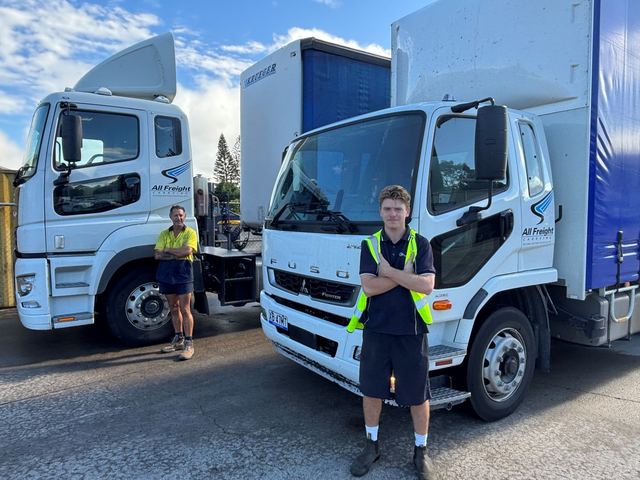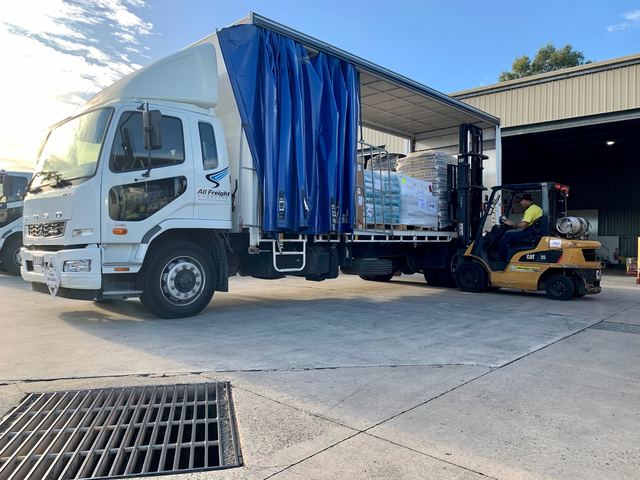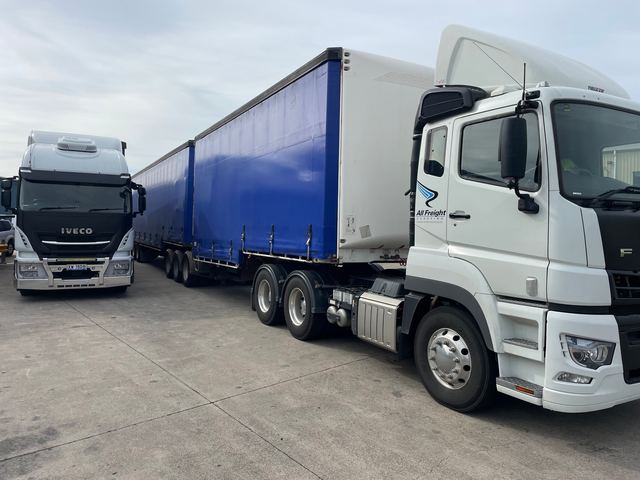



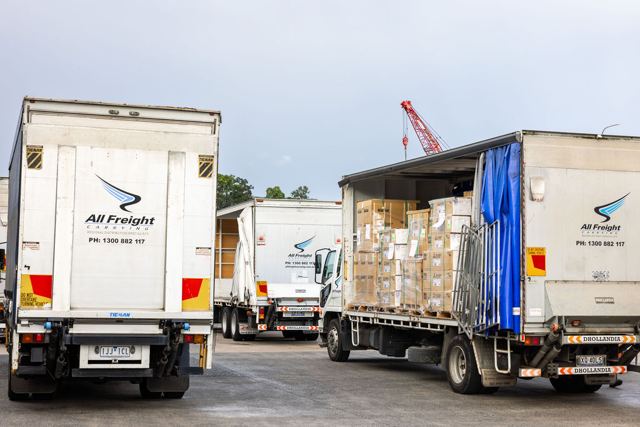
All Freight Carrying delivers freight on the Sunshine Coast from its own depot at Yandina. Parcels, cartons, pallets and full loads collected anywhere in Brisbane run north overnight and go out on fixed local runs the next business day. Freight collected on the coast, in Gympie or in northern Moreton Bay is delivered locally, sent to Brisbane, or consolidated at Yandina for the rest of Australia. The business is a Sunshine Coast family operation that has run its own vans, trucks and trailers for 20+ years, with All Freight Carrying Pty Ltd and Parcel Link Pty Ltd operating together from the one depot.
This guide is for the people who send that freight: Brisbane wholesalers with Sunshine Coast customers, coast businesses bringing stock in and sending orders out, and anyone with a pallet to move. Each section gives the short answer first, then the detail, then a link to the page that covers it fully.
- Who delivers freight on the Sunshine Coast?
- How long does freight take from Brisbane?
- Parcels, cartons or pallets: what is the difference?
- Which areas are covered?
- What if the receiver has no forklift?
- How to book and what details you need
- What affects the cost?
- Local carrier, Brisbane-based carrier, national courier or broker: how to choose
- Urgent freight
- Interstate freight from the Coast
- Tracking and proof of delivery
- Peak season and holiday closures
Who delivers freight on the Sunshine Coast?
Freight on the Sunshine Coast is delivered by four kinds of operator — local carriers with their own depot on the coast, Brisbane-based carriers that run up the highway, national networks and their local agents, and brokers that resell someone else’s service — and All Freight Carrying is in the first group, carrying freight on its own vehicles, with its own drivers, through its own depot at 48 Central Park Drive, Yandina.
Two companies make up the business: All Freight Carrying runs the trucks, pallets, full and part loads and the overnight Brisbane linehaul, and Parcel Link runs the parcel side on late-model vans with their own carousel sort at the depot. For the customer the split is invisible: one pickup, one account and one phone number cover both. A large fleet runs every business day out of Yandina: 1- and 2-tonne parcel and delivery vans, most on permanent set runs and the rest on hourly hire, plus 12- and 14-pallet rigid curtainsiders with tailgates, pantech trucks and prime movers pulling single and B-double trailers, with backup vehicles behind them. Each permanent run has its own driver, who knows the dock, the gate code and who to ask for. The depot is a two-acre cross-dock site with a parcel carousel, alarmed and covered by CCTV.
The business is also the Sunshine Coast and Gympie pickup and delivery agent for national freight carriers, which is why a parcel booked through a national network can arrive in an All Freight Carrying or Parcel Link van; see why All Freight Carrying is delivering your parcel. Local freight company or freight broker sets out the difference between a carrier and a reseller, and our fleet lists every vehicle type.
How long does freight take from Brisbane?
Freight collected in Brisbane is delivered across the daily Sunshine Coast, Noosa, Gympie and Caboolture areas the next business day: it is collected during the day, travels north on the overnight linehaul to Yandina, is sorted early the next morning and goes out on that day’s run. Hinterland, rural and island areas are delivered on their next set service day each week, and transit times are estimates, confirmed with every quote.
The same pattern applies on every core lane, as the transit times page sets out:
| Lane | How it runs | Transit |
|---|---|---|
| Brisbane to Sunshine Coast & Noosa | Overnight to Yandina, out on the morning run | Next business day |
| Brisbane to Gympie & the Cooloola Region | Gympie, Southside, Monkland and the Bruce Highway corridor; the Mary Valley on set service days | Next business day |
| Brisbane to Caboolture & Moreton Bay | Daily-service suburbs; Bribie Island on set service days | Next business day |
| Sunshine Coast to Sunshine Coast | Picked up on the coast, sorted at Yandina, out on the daily runs | Next business day |
| Sunshine Coast & Gympie to Brisbane | Into Brisbane on the same daily service | Next business day |
The clock starts from pickup, not from booking, and does not count the day of collection, weekends or public holidays. The delivery area sets the day: a pallet for Maroochydore goes out on the next morning’s run, while a pallet for a hinterland town waits for that town’s service day, so if you have a deadline, say so when you book. The Brisbane to Sunshine Coast freight page covers the lane in detail; the reverse direction is on Sunshine Coast to Brisbane freight.
Parcels, cartons or pallets: what is the difference?
The difference is how the freight is handled and which part of the fleet carries it: parcels and cartons are handled by hand, travel on Parcel Link’s van runs and go through the parcel carousel at Yandina, while pallets and skids travel on All Freight Carrying’s curtainsiders and trailers and are moved by forklift or tailgate. All of them can go on the one booking, and on the Brisbane lane they travel on the same overnight linehaul.
If you are sending more than a handful of cartons to the same address, putting them on a pallet is usually safer and often cheaper. The Australian standard pallet measures 1165 × 1165 mm, often rounded to 1.2 × 1.2 m, and as a general guide a pallet should be kept under about 1.8 m high including the base, stacked square with the heaviest items at the bottom, no overhang, and shrink-wrapped to the base. Non-standard pallets, long lengths and awkward items are fine to send; give the actual dimensions so the right vehicle is allocated. Full and part loads go on a rigid truck, single trailer or B-double: the rigid curtainsiders carry 12 to 14 standard pallet spaces, a single semi-trailer about 22 and a B-double about 34, so a job can run from one carton to a full B-double without leaving the fleet. See parcel delivery, pallet freight and full loads, standard pallet sizes in Australia and the packaging guide.
Which areas are covered?
Deliveries cover 268 suburbs across six service areas — the Sunshine Coast from Caloundra to Noosa, the hinterland, Gympie and the Cooloola region, and northern Moreton Bay including Caboolture and Bribie Island — with collections from a further 405 suburbs across all of Brisbane. The coastal centres, Nambour, Gympie and Caboolture get a delivery every business day; hinterland, rural and island areas run on set days each week; some outlying and island areas are served on request.
| Service area | Suburbs | How often we run |
|---|---|---|
| Maroochydore, Buderim & Mooloolaba | 14 | 14 every business day |
| Caloundra & Kawana | 26 | 26 every business day |
| Noosa, Coolum & the North Shore | 35 | 24 every business day, 9 on set service days, 2 on request |
| Nambour & the Hinterland | 67 | 13 every business day, 45 on set service days, 9 on request |
| Gympie & the Cooloola Region | 99 | 9 every business day, 79 on set service days, 11 on request |
| Caboolture, Moreton Bay & Bribie Island | 27 | 7 every business day, 15 on set service days, 5 on request |
| Brisbane collections | 405 | 405 collected every business day |
The set-day areas are the Blackall Range towns such as Maleny, Montville and Kenilworth, the Glass House Mountains, the Mary Valley, the Gympie district beyond the city, and Bribie Island; the on-request localities include Rainbow Beach, Tin Can Bay, Cooloola Cove and the Noosa North Shore. Brisbane collections cover every area of the metropolitan region, including Pine Rivers, Redcliffe, Logan, the Redlands and Ipswich. The network does not do Brisbane to Brisbane deliveries, and refrigerated or temperature-controlled goods are not carried unless agreed in writing first. See the service areas page for every suburb with its frequency, Brisbane collection areas for the pickup side, and freight to Rainbow Beach, Tin Can Bay and the hinterland for the outlying areas.
What if the receiver has no forklift?
If there is no forklift and no loading dock at the delivery address, book a tailgate delivery: the pallet arrives on a truck fitted with a hydraulic lifting platform, the driver rolls it onto the platform with a pallet jack, lowers it to the ground and moves it off, and nobody at the address has to lift anything. Several of the rigid trucks carry tailgate lifters, which covers most homes and many small business and building site addresses.
A tailgate has limits. The pallet is lowered to firm, level, hard ground at the back of the truck — concrete or bitumen, not grass, gravel or a steep driveway, because a pallet jack cannot move a heavy pallet over those. Moving the freight further, inside or upstairs, is not included; tailgate and residential deliveries are made at ground level to the front door, kerbside or the nearest safe point. Every tailgate has a lifting limit, so the weight of each pallet needs to be on the booking, and if there is no forklift at the pickup end either, ask for a tailgate pickup too. A pallet arriving on a standard truck at an address with no way of getting it off is the single most common avoidable cause of a failed delivery; a tailgate usually carries an extra charge, but that is far cheaper than a wasted trip. Read tailgate delivery explained for how to book it, and business vs residential delivery for what changes when the address is a home.
How to book and what details you need
To book freight, call 1300 882 117 between 8:00am and 4:00pm Monday to Friday, or request a quote online at any time and the office replies with a price and a transit time; no account is needed for a one-off job, and the day before is the ideal time to book a pickup so the run can be planned around it. Regular senders can open a credit account for set rates, monthly invoicing and direct booking, and many set up a standing daily or weekly pickup rather than booking each job.
Quotes are based on what you declare and the vehicle is chosen on the same information, so have these ready:
- Full pickup and delivery addresses, including any unit, suite, shop or warehouse number.
- A contact name and mobile number at each end, for the person who will actually hand over or receive the freight.
- Receiving hours, and any day the site is closed.
- What the freight is, how many items, and the dimensions and weight of each item or pallet.
- Whether there is a forklift or a dock at each end, and a tailgate request if there is neither.
- Anything about access a driver would not expect: narrow or steep driveways, height limits, gate codes.
- Any purchase order or booking reference the receiver needs, and for homes, authority-to-leave instructions.
- Whether anything is dangerous goods, or contains liquids, fuel, oil, chemicals or batteries; dangerous goods are carried only where they are declared in writing before booking and accepted in writing.
Then label every item with the receiver’s name, address and phone number, have the freight ready before the vehicle arrives, and tell the receiver it is coming. The step-by-step version is in how to book a freight pickup on the Sunshine Coast, the paperwork is covered in how to fill out a consignment note, and the quickest way to start is the quote form. Anyone sending aerosols, paint, chemicals or batteries should read what you must declare first.
What affects the cost?
The cost of a consignment is set by its chargeable weight, the lane and delivery area it travels on, and the extra services the job needs, with a fuel levy applied on top at the rate current on the day of carriage, which is why every quote is given against the actual addresses and the actual freight.
| Factor | What it means | How to keep it down |
|---|---|---|
| Cubic weight | Charges are calculated on the greater of dead weight and cubic weight, so light, bulky freight is charged on the space it takes up | Use cartons just big enough for the item; no overhang on pallets |
| Fuel levy | A separate charge that moves with diesel prices, applied at the rate current on the day of carriage | A lower base charge means a lower levy |
| Residential delivery | Homes need more time, more contact and often a tailgate; chargeable as an additional service | Give authority-to-leave instructions and a contact who answers |
| Tailgate | A specially equipped truck and more time on site | Book it at quote stage |
| Set-day and remote areas | Hinterland, rural, island and on-request localities are served less often and are further from the depot | Group consignments onto the same service day |
| Declared weight and dimensions | Consignments may be weighed, measured and cubed, and charges adjusted if the actual profile differs from what was declared | Measure and weigh before you book |
Waiting time, oversize handling, re-labelling, redelivery, return and storage are each chargeable as additional services, and tolls and government charges are passed through at cost. Use the cubic weight calculator to work out chargeable weight, the fuel levy calculator to check the levy on an invoice, and how much it costs to send a pallet from Brisbane to the Sunshine Coast for what sets the price of a pallet on that lane.
Local carrier, Brisbane-based carrier, national courier or broker: how to choose
Choose on where the freight is sorted and who is responsible for it once it leaves your dock: a local carrier sorts it at a depot on the coast and delivers it with its own drivers, a Brisbane-based carrier sorts it in Brisbane and sends a vehicle up the highway or hands it to a local subcontractor, a national courier network moves it through its own hubs and often gives the last leg to a local agent, and a broker sells you space on one of the other three without running a vehicle itself. Each suits a different sender: regular freight into the coast, Noosa, Gympie and Moreton Bay; freight that mostly stays in Brisbane; freight going to many destinations from one account; or one invoice across many lanes.
Questions that separate them quickly: Who owns the vehicle that will arrive at my receiver’s door? If a delivery fails, who do I call, and can they see the scan and reach the driver? Does the quote include the tailgate, the residential delivery and the fuel levy? The answers tell you more than the price does. Local vs Brisbane-based freight companies works through the comparison for freight bound for the coast, and how to choose a freight company lists the ten things to check before you hand freight to anyone.
Urgent freight
Urgent freight is sent on a dedicated vehicle straight from pickup to delivery, with no depot, no sort and no other consignments on board, and it is dispatched as soon as a suitable vehicle is available during office hours. Because nothing else shares the vehicle, you pay for the whole trip rather than a space on it, which is why most freight does not need it.
A dedicated vehicle earns its keep when the cost of waiting for the next scheduled run is greater than the cost of the trip: a breakdown part for a machine that is down, materials a crew cannot start without, freight that missed the night linehaul, or a consignment too fragile to share a load. It is quoted per job, so have the addresses, contacts, dimensions and weights, the forklift situation at each end and the deadline ready, and you will be told honestly whether the deadline can be met before the vehicle leaves. Booking the scheduled service a day earlier is often the cheaper answer. See urgent and hot shot freight for how the service works and hot shot or overnight freight for the questions that settle which one a consignment needs.
Interstate freight from the Coast
Interstate freight from the Sunshine Coast is collected on the same local runs, consolidated at the Yandina depot and sent out on established national carrier networks to every capital city and regional Australia, so the one pickup that takes your local and Brisbane freight takes your interstate freight too. A consignment collected in Maroochydore, Caloundra, Noosa, Nambour, Gympie or Caboolture leaves on the same linehaul with the same transit estimate, and a satchel, a carton, a skid and a pallet all travel on the same service.
| Destination | Estimated transit from the Sunshine Coast |
|---|---|
| Brisbane, Gold Coast, Toowoomba | Next business day |
| Sydney, Newcastle, Melbourne | 2–3 business days |
| Canberra | 3–4 business days |
| Adelaide | 4–5 business days |
| Perth | 5–6 business days |
| Hobart, Darwin | 6–7 business days |
These are estimates only, in business days from pickup, excluding weekends, public holidays and the day of collection; a regional town can take longer than the capital it sits near, because freight travels to the capital first and is delivered outwards from there. If the freight is dangerous goods, the national carrier network’s acceptance rules apply as well as ours. The interstate freight page covers the service, and the transit times page has a checker for any locality in Australia.
Tracking and proof of delivery
Every consignment is scanned at pickup, into the Yandina depot, onto the delivery vehicle and again at delivery, and the delivery scan carries a GPS-stamped photo or a signature with the time and the location. Enter the consignment number in the tracking portal and every scan is there.
- Picked up — collected from the sender and scanned onto the vehicle.
- In depot — at Yandina, sorted and waiting for its delivery run.
- On board for delivery — loaded on the van or truck doing your area today.
- Delivered — signed or photographed at the delivery address.
- Held — with us, but not going out yet: awaiting a booking, payment, an address correction, a ready receiver or the next service day.
- Futile — delivery was attempted and could not be completed.
Held and futile freight is reviewed every day, along with every other scan status, so a failed attempt is followed up the day it happens. After a futile attempt the freight comes back to the depot and the office contacts the sender or receiver to arrange a redelivery, an appointment, a collection from the depot or a return to sender. A futile attempt and the redelivery are both chargeable, and almost every one was preventable with the details on the booking. Go to track your freight to look up a consignment, futile deliveries and how to avoid them for the details that prevent most failed attempts, and damaged freight: what to do if something arrives in worse condition than it left.
Peak season and holiday closures
From late October to Christmas, freight volumes across the Sunshine Coast, Noosa and Gympie climb sharply as retailers stock up and online orders surge, and All Freight Carrying plans for a lift of at least 30 to 40 per cent through the peak, scaling up its fleet and team from late October. Every carrier gets busier at the same time, and interstate transit times stretch in December.
The planning that makes the difference happens in October and November: tell the office your forecast early, bring Christmas stock up from Brisbane or interstate before the busiest weeks of December, set up a standing pickup rather than a string of one-off bookings, and get the delivery details right, because a failed delivery costs more time in December than at any other time of year.
Closing dates are confirmed each year: the last pickup and delivery dates before Christmas and any close-down period are communicated ahead of time, so check with the office in November for the current year’s dates. The peak also overlaps with the wet season, when summer storms and flooding can close roads across the hinterland, Gympie and Moreton Bay; the business monitors weather closely, never puts its people in harm’s way, keeps customers informed, and holds freight securely at the depot until it is safe to travel. Christmas peak freight: tips for Sunshine Coast businesses has the full checklist, and freight during floods on the Sunshine Coast explains what happens when the weather intervenes.
The short version: decide whether it is a parcel, a carton or a pallet; check which service area the receiver is in; find out whether there is a forklift at the other end; and put the full address, a contact who answers the phone and the real dimensions and weight on the booking. Request a quote with the pickup suburb, the delivery suburb and what you are sending, or call the Yandina office on 1300 882 117 between 8:00am and 4:00pm Monday to Friday. The freight guides and freight questions answered cover anything this guide has not.
Published by All Freight Carrying, Yandina, Sunshine Coast · 1 November 2026 · Last updated 1 November 2026