


Australia uses a different standard pallet from most of the world, and it affects how freight is loaded, priced and stored. Here is what you need to know before you build a pallet for road freight.
The Australian standard pallet
The Australian standard pallet measures 1165 × 1165 mm, often rounded to 1.2 × 1.2 m. It was designed to fit Australian rail wagons and is the most common pallet in local supply chains, including the pooled pallets hired from CHEP and Loscam. Freight networks usually quote and plan pallet space around this size.
Other pallet sizes you will see
| Pallet | Size | Where it is used |
|---|---|---|
| Australian standard | 1165 × 1165 mm | Most Australian freight and warehousing |
| Euro pallet | 1200 × 800 mm | Imported European goods |
| US / ISO pallet | 1219 × 1016 mm (48 × 40 in) | Imported North American goods |
| Half pallet | about 1165 × 580 mm | Retail displays and smaller loads |
Non-standard pallets are fine to send. Just give us the actual dimensions so the right space is allowed.
How high and how heavy?
As a general guide for road freight, keep pallets under about 1.8 m high including the base — carriers price a standard pallet space up to about 2.0 m, but a lower pallet is more stable and easier to handle. Taller pallets become unstable, may not fit some vehicles or racking, and are harder to handle safely. Most freight pallets weigh between 300 and 1,000 kg. If your pallet is heavier than 1,000 kg, taller than 1.8 m, or has an unusual shape, tell us when you book so we can allocate the right vehicle and equipment.
How many pallets fit on a truck?
| Vehicle | Typical standard pallet spaces |
|---|---|
| Rigid truck (curtainsider) | 12 to 14 |
| Single semi-trailer | about 22 |
| B-double | about 34 |
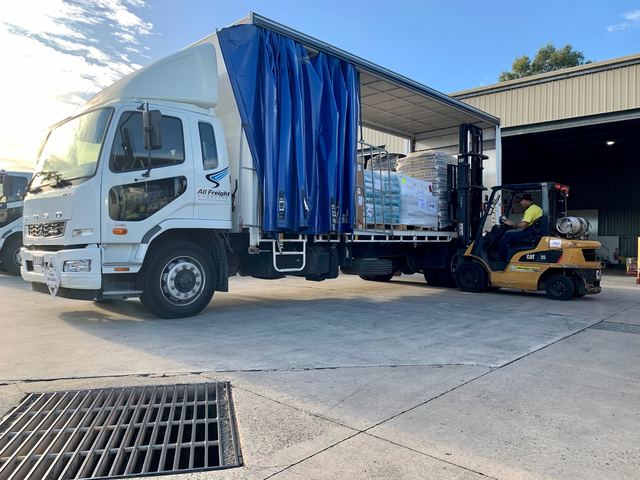
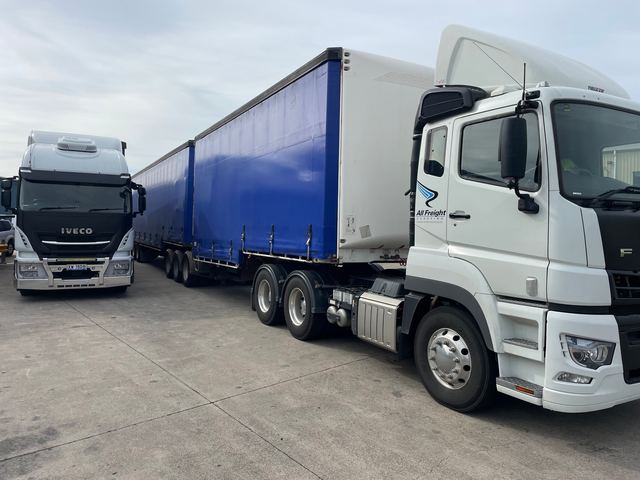
Exact capacity depends on the trailer, the pallet sizes and the weight. Heavy freight can reach the vehicle’s weight limit before it runs out of floor space. We run 12 and 14-pallet curtainsiders, single trailers and B-double sets with mezzanine floors. See pallets & full loads.
Tips for a road-ready pallet
- Use a sound pallet with no broken boards.
- Stack square, heaviest at the bottom, with no overhang.
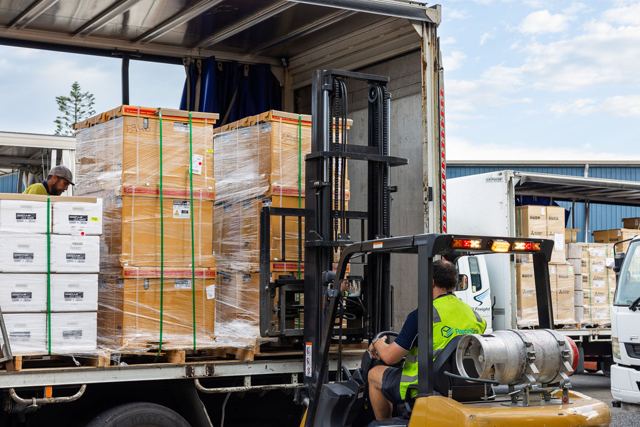
- Shrink-wrap the load to the pallet base and strap heavy loads.
- Label at least two sides.
- Complete pallet transfer paperwork if you use hire pallets.
Published by All Freight Carrying, Yandina, Sunshine Coast · 20 October 2026 · Last updated 25 October 2026