


Freight going into a retail distribution centre has to be booked into a delivery slot before the vehicle leaves, and All Freight Carrying makes that booking, builds and labels the pallets to the receiving centre’s requirements, delivers inside the window and confirms it back to you. If you have just won a retail account, this guide explains why distribution centres work that way, what they ask for, what gets loads turned away at the gate, and how a book-in service removes the problem from your desk.
Why distribution centres run booking slots
A distribution centre is a scheduling problem, not a warehouse. A small number of inwards doors have to absorb hundreds of inbound vehicles a day, each one needing a forklift, a dock, a receiving clerk and space on the floor to break the load down. If vehicles turned up whenever they liked, the yard would gridlock and the whole site would stop.
So the centre sells time instead of space. Every inbound delivery is allocated a window, usually through a booking portal, and the centre plans its labour around what has been booked. Arrive outside your window and there may be no dock, no forklift driver and no obligation to take your freight. Arrive without a booking at all and you will almost certainly be turned away.
The same logic drives the rest of their requirements. Pallets have to be a standard size and shape so they can be handled by machine and racked without rework. Labels have to be readable in a set place so they can be scanned on the way past. Paperwork has to match the purchase order so the receipt can be processed without somebody walking the floor to work out what arrived.
What you need before you can book
Bookings are made against an order, not against a vehicle, so the details have to be settled first:
- The purchase order number, or several if the delivery covers more than one order.
- The receiving site, which is often not the store or the head office you deal with.
- The total number of pallets, cartons and units, and the pallet configuration.
- Whether the pallets are standard or oversize, and the height of each one.
- The pallet account details if pooled hire pallets are being transferred.
- The carrier and vehicle type, since some sites restrict trailer lengths or require a tailgate or a particular dock.
- Any advanced shipping notice the centre expects before the vehicle arrives.
The practical catch is that most of this is only knowable once the freight is actually built. A booking made against a guess, and pallets that turn out different on the day, is one of the most common reasons a delivery goes wrong.
Labelling: get it readable and get it in the right place
Distribution centres scan rather than read. Typical requirements are a pallet label on two adjacent sides, placed at a consistent height and not wrapped over with film so the barcode cannot be scanned, carton labels that are not obscured by tape or printed over a seam, a legible purchase order number on the pallet label, and old labels removed rather than crossed out. A pallet that cannot be scanned has to be handled by hand, and that is when a non-conformance gets raised against your account.
Palletising to standard
The pallet itself is part of the specification. As a general rule for retail deliveries:
- Use a sound pallet of the size the centre specifies. The Australian standard pallet is 1165 × 1165 mm; some centres want a specific pooled pallet type. Broken boards or missing blocks are a rejection in their own right. Our guide to Australian pallet sizes covers the dimensions.
- No overhang. Cartons must sit inside the footprint of the pallet. Overhang blocks racking, crushes product and is one of the easiest things for a receiving clerk to pick up.
- Respect the height limit. Centres specify a maximum pallet height, and it is often lower than a carrier’s pallet space. Build to their figure, including the pallet base.
- Keep the stack square and the top flat so the pallet is stable in a trailer and safe for a forklift.
- Follow the product rules. Many centres require one product per pallet, or layers kept to one product, with mixed pallets clearly marked.
- Wrap to the base. Film must bind the load to the pallet, not just around the cartons, with enough tension to survive a trailer and a dock.
Our guide to packaging freight so it arrives undamaged goes through carton strength, wrapping and strapping in more detail.
What actually goes wrong
- No booking, or a booking for the wrong day. The vehicle arrives and there is no slot.
- Arriving outside the window. Even a well-presented load can be refused if it misses the slot, because the labour behind it has moved on.
- Pallet details that do not match the booking. Four pallets booked, five delivered, or pallets taller than declared.
- Overhang, height breaches and unstable loads. The most common presentation failures.
- Labels that cannot be scanned, or purchase order numbers that do not match the paperwork.
- Missing or wrong documents, including advanced shipping notices and pallet transfer dockets.
- Freight short or over against the order, which turns into a claim rather than a receipt.
The cost of any of these is the same unpleasant list: the freight comes back, you pay for the delivery and the return, a non-conformance goes on your supplier record, and the shelf stays empty until the next slot. Suppliers rarely get into trouble for one rejection, but a pattern of them puts an account at risk.
How our book-in service handles it
This is the part most suppliers would rather not run themselves, and it is the part we take on. Our retail and distribution centre delivery service works like this:
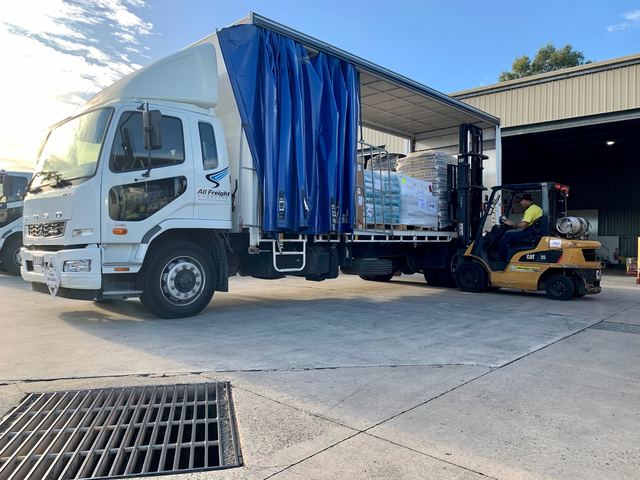
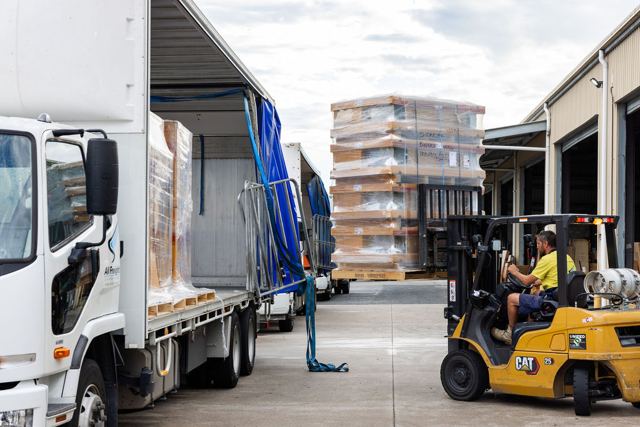
- Collect and cross-dock. We collect from your site, or you deliver to our Yandina depot. Freight is cross-docked rather than sitting in storage you are paying for.
- Sort and consolidate. Orders are sorted and held so several can travel as one full, compliant delivery instead of several part loads.
- Palletise to standard. We receive loose cartons, build the pallets, then wrap and label them to the receiving centre’s requirements, with the height and overhang right.
- Make the booking. We take the slot that works for the run, so you are not chasing a portal or sitting in a phone queue, and the booking is made on the pallet configuration that actually exists.
- Deliver inside the window on our own vehicles with our own drivers, with the run planned around the booked slot.
- Confirm it back. Every consignment is scanned with proof of delivery, so you know it landed and when.
If a slot cannot be met for any reason, we tell you before it becomes a problem and rebook it. If you need stock held and released order by order rather than cross-docked, our warehousing at Yandina does that from the same building, and deliveries to centres outside South East Queensland go on established national carrier networks, after being consolidated and palletised here, booked and tracked by us.
A checklist before the vehicle leaves
- Booking made, with a reference, for the right site and the right day.
- Purchase orders listed, and the paperwork matching the freight exactly.
- Pallet count, carton count and heights the same as the booking.
- Pallets sound, square, within the height limit and free of overhang.
- Labels on two sides, scannable and not covered by film.
- Advanced shipping notice sent, if the centre requires one.
- Pallet transfer paperwork completed for pooled pallets.
- A contact at your end who can answer a question while the vehicle is at the gate.
Talk to us about your account
Tell us the product, the order pattern and where it has to land, and we will tell you how we would run it. Call 1300 882 117 between 8:00am and 4:00pm Monday to Friday, email cs@allfreightcarrying.com.au, or request a quote. Our depot is at 48 Central Park Drive, Yandina QLD 4561, and the pallet freight page covers the vehicles behind the service.
Published by All Freight Carrying, Yandina, Sunshine Coast · 31 October 2026 · Last updated 31 October 2026