


An empty Australian standard timber pallet weighs roughly 30 to 40 kg, a loaded freight pallet usually weighs between 300 and 1,000 kg, and All Freight Carrying asks for the real weight and dimensions of every pallet because they decide which vehicle, which equipment and which price applies. This guide gives typical empty weights by pallet type, what loaded pallets weigh in practice, how high you can safely build one, and how to weigh and measure a pallet before you book.
How much does an empty pallet weigh?
An empty pallet weighs anywhere from about 10 kg to about 40 kg depending on its size, material and construction. The figures below are typical ranges rather than specifications, because timber density, moisture content and the number of boards all vary from pallet to pallet.
| Pallet type | Size | Typical empty weight |
|---|---|---|
| Australian standard, hardwood timber | 1165 × 1165 mm | about 30 to 40 kg |
| Australian standard, softwood timber | 1165 × 1165 mm | about 20 to 30 kg |
| Plastic pooled pallet (CHEP-style) | 1165 × 1165 mm | about 20 to 30 kg |
| Euro pallet, timber | 1200 × 800 mm | about 20 to 25 kg |
| US pallet, timber | 1219 × 1016 mm | about 15 to 25 kg |
| Half pallet, timber | about 1165 × 580 mm | about 10 to 15 kg |
The pooled hardwood pallets that most grocery and retail freight travels on sit at the heavy end of the first row, which is why a pallet of light cartons can still be a two-person lift once the base is counted. Our guide to CHEP and Loscam pallets explains how those pooled pallets are hired and transferred, and our guide to standard pallet sizes covers the dimensions themselves.
How much does a loaded pallet weigh?
Most loaded freight pallets weigh between 300 and 1,000 kg, with the pallet base included. A pallet of cartoned goods, hardware or packaged food usually sits in the middle of that range. Beverages, tiles, paper, fasteners and anything in drums or bags push towards the top of it and beyond. A pallet of bulky but light goods, such as foam, packaging or empty containers, can weigh under 200 kg and still fill a full pallet space.
Anything over 1,000 kg is heavy freight and needs to be flagged when you book. A heavy pallet may be within what a truck can carry but beyond what a tailgate can lift or what a pallet jack can move, and heavy freight can reach a vehicle’s weight limit before it runs out of floor space.
Why do carriers ask for the real weight?
Carriers ask for the real weight because it is the figure the whole job is planned on: the vehicle, the equipment at each end, the position of the pallet on the load, and the legal mass of the vehicle on the road. A guess that is a few hundred kilograms light can send a truck with the wrong tailgate, put a pallet on a vehicle that is then overweight, or leave a driver unable to unload at the address. Under our Conditions of Carriage we may weigh, measure, cube, scan or photograph any consignment, our records are evidence of its weight and dimensions, and charges are adjusted to the actual profile if it differs from what was declared. Declaring honestly is cheaper and simpler than being re-rated afterwards.
How high can you load a pallet?
A common working limit for pallet freight on curtainsiders is around 1.8 m loaded height including the base. Carriers often price a standard pallet space up to about 2.0 m, but a lower pallet is more stable, fits more vehicles and racking, and is easier to handle safely. Tall pallets lean, shift under strapping and are the ones that arrive damaged. If your pallet is taller than 1.8 m, heavier than 1,000 kg or an unusual shape, tell us when you book so the right vehicle and equipment can be allocated.
Height is also governed by what is underneath. A hardwood pooled pallet can carry a far heavier, taller load than a light one-way softwood pallet, and a stack that would be fine on the first will crush the second.
Why do declared weight and dimensions matter so much?
Declared weight and dimensions matter because four separate things depend on them.
- Cubic weight. Freight is charged on the greater of actual weight and cubic weight, converted at 250 kg per cubic metre. A light, tall pallet is charged on the space it occupies, not the scales, so dimensions set the price as much as weight does. Our cubic weight calculator does the arithmetic.
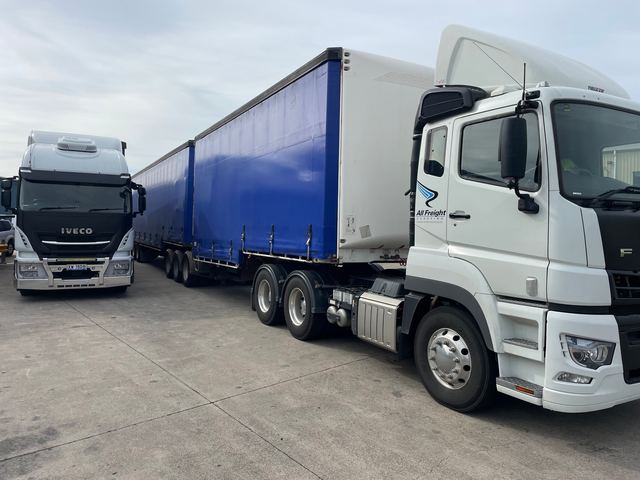
- Vehicle selection. Pallet spaces on a vehicle are a floor-space figure and a weight figure at the same time. A rigid curtainsider carries around 12 to 14 standard pallet spaces, a single semi-trailer about 22 and a B-double about 34, but a load of heavy pallets reaches the vehicle’s mass limit before the floor is full. We run 12 and 14-pallet curtainsiders, single trailers and B-double sets, and the weight decides which one your freight goes on.
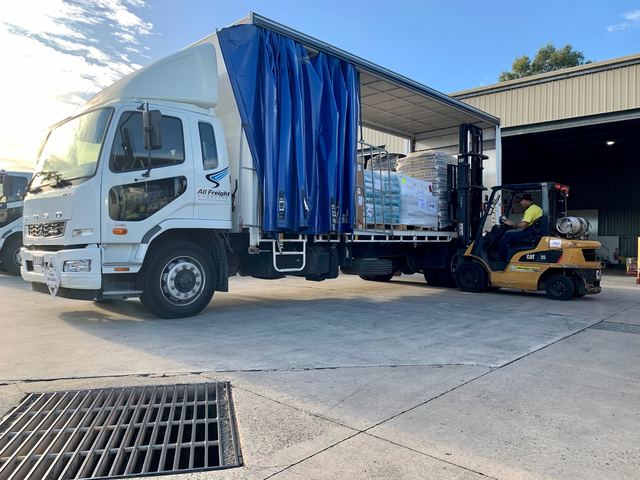
- Tailgate limits. Every tailgate has a lifting limit, and a pallet jack can only move a pallet of a certain weight over firm, level ground. The weight of each pallet decides whether a tailgate delivery is possible at all, and which truck has to come.
- Chain of Responsibility mass limits. Under the Heavy Vehicle National Law, a sender must give accurate mass, dimension and load information, because an overloaded vehicle is a breach for everyone in the chain, not just the driver. Our guide to Chain of Responsibility explains what that means for senders and receivers.
How do you weigh and measure a pallet?
Weigh the whole pallet, base included, on a pallet scale, a floor scale or a forklift with a weighing attachment if you have one. If you do not, add it up: the weight of one carton or unit multiplied by the number on the pallet, plus the empty weight of the pallet from the table above, plus wrap and strapping. Round up, not down. For regular senders of heavy freight a weighbridge ticket for a full load settles the question once and for all.
To measure, take the longest length, the widest width and the full height from the floor to the highest point of the load, including the pallet base and any overhang or packaging that sticks out. Overhang counts, because it is the space the pallet actually occupies on the truck, and it should be avoided anyway: freight should not overhang the pallet unless agreed, and overhanging cartons are one of the most common causes of damage. Stack square, heaviest at the bottom, and shrink-wrap the load to the pallet base before you measure the final height.
How does it work with All Freight Carrying?
When you book a pallet with us, we need the number of pallets, the length, width and height of each including the base, the weight of each, the pallet type, and whether there is a forklift or a dock at each end. If there is neither, ask for a tailgate pickup or delivery when you book: the ground at the address needs to be firm, level and hard, such as concrete or bitumen, and the pallet is lowered to the ground at the back of the truck rather than carried inside. Each pallet’s weight tells us which tailgate truck to send. Our fleet runs from parcel vans through rigid curtainsiders and tailgate trucks to single and B-double trailers, so the right vehicle is a matter of knowing the freight.
Give us the real figures and the quote, the vehicle and the delivery will match. Get a quote online or call 1300 882 117, Monday to Friday 8:00am to 4:00pm.
Published by All Freight Carrying, Yandina, Sunshine Coast · 1 November 2026 · Last updated 1 November 2026