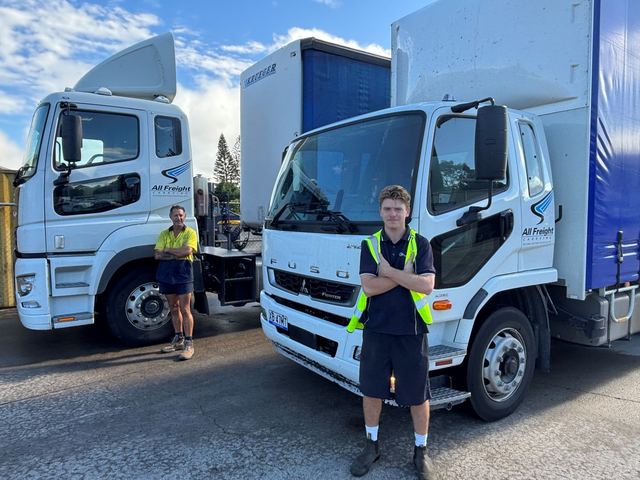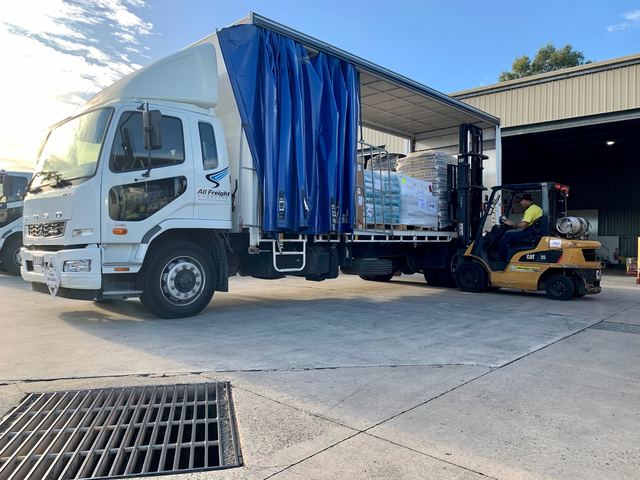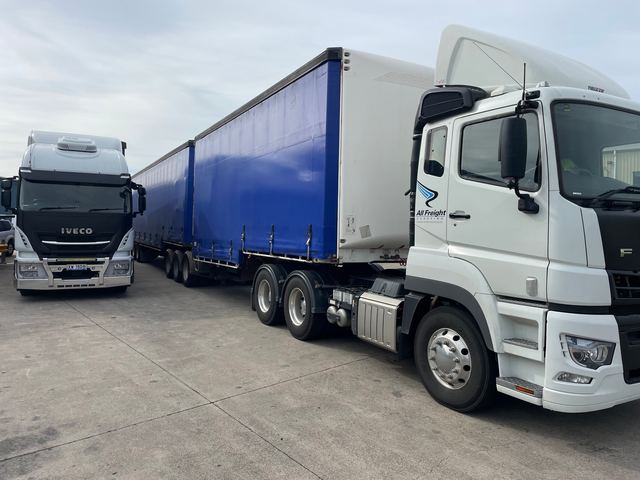



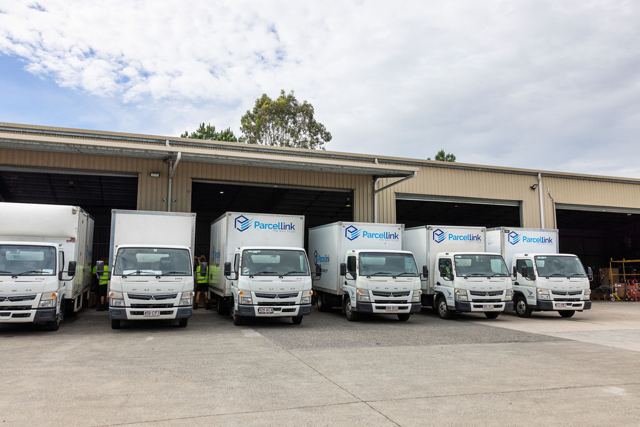
A local freight company like All Freight Carrying carries your freight on its own trucks, with its own drivers, through its own depot; a freight broker owns none of that and instead resells space on somebody else’s carrier. Both can move a pallet from A to B. The difference shows up in who is accountable when something goes wrong, what tracking you can see, and who handles a damage claim.
This page sets out how each model works and where each one genuinely fits. It is written to be fair to brokers. There are jobs they do well, and we use established national carrier networks ourselves for interstate freight, booked and tracked by us from Yandina, which we say plainly further down.
What a local freight company is
A local or regional freight company owns the links in the chain for the area it covers. That normally means:
- Its own depot, where freight is unloaded, sorted and loaded again.
- Its own vehicles, from parcel vans through to tailgate trucks and trailers.
- Its own drivers, employed and on set runs rather than hired job by job.
- Its own scanning system, so every movement of your consignment is recorded under one roof.
- Its own customer service, in the same building as the freight.
For us that is a two-acre depot at Yandina with a cross-dock and a parcel carousel, set runs that go out every business day, and local drivers who know the docks, the back lanes and the receivers. We publish every suburb we service and how often we run there on our service areas page: 268 delivery suburbs across six service areas, plus collections from 405 suburbs across Brisbane and the whole Gold Coast. After 20+ years and more than 3,200,000 deliveries, the answer to “do you deliver to my suburb, and on what day?” is a fact we can read off a run card rather than a promise to look into it.
What a freight broker is
A broker sells transport it does not perform. You will also see the same model described as a freight agent, a freight forwarder or an online freight marketplace. The broker takes your booking, buys the movement from a carrier at a wholesale rate, sells it to you at a retail rate and keeps the margin. It may have no depot, no vehicles and no drivers at all.
None of that is dishonest, and a good broker adds genuine value by knowing which carrier suits which lane. The point to understand is simply that your freight is handled by a company you have no direct relationship with, and on longer movements often by two or three of them in sequence.
Accountability when something goes wrong
Most freight arrives without drama either way. The models separate on the day it does not.
With a local carrier, one business holds the freight, the record and the phone. Ring us and the person you speak to can look at the scan history, call the driver who has the consignment on board and tell you where it is. If it was not delivered, we can usually tell you why in the same call.
With a broker, the business you booked with does not have your freight and cannot see inside the carrier’s operation beyond what that carrier’s portal shows. Your question is relayed, the answer comes back, and nobody in the chain has both the full picture and a reason to own the outcome. Where several carriers have handled the consignment, working out which one has it can take longer than the delivery would have.
Tracking and proof of delivery
A carrier that runs its own network scans freight at pickup, at the depot and at delivery, and finishes with a signature or a photo carrying a GPS and time stamp. Our tracking and technology page shows what that looks like from a customer’s side.
A broker can only pass on whatever its carrier provides, in whatever form that carrier provides it. Sometimes that is a full scan history. Sometimes it is a status emailed through on request, with no proof of delivery document you can forward to your own customer.
Damage, loss and claims
Every freight movement is carried on somebody’s conditions of carriage. Before you book, it is worth knowing whose. Ours are published in full as our conditions of carriage, so you can read what we are liable for, what we are not and how a claim is made, without asking us for a copy.
When a local carrier damages freight, you claim against the company you dealt with, and the people assessing the claim are the people who handled the freight. When a broker’s carrier damages freight, there is an extra party in the middle: you claim against the broker, the broker claims against the carrier, and the terms that actually govern the movement may be the carrier’s rather than the ones you were shown. Ask which set applies and who assesses the claim.
Why a broker quote can look cheaper
Brokers buy at volume rates, so a quote can genuinely come in under a direct rate on a lane where their carrier is strong. On other lanes the margin simply sits on top of a rate you could have had yourself. Either way, compare quotes on the same basis: what the rate covers, how the freight is measured, and what is charged on top. Our guide on why the cheapest freight quote can cost more goes through the charges that tend to appear after the fact, and cubic weight explains how large, light freight is measured in the first place.
When a broker genuinely makes sense
- One-off freight on an unusual lane where no single carrier covers both ends.
- International freight, where a forwarder handles customs and documentation.
- Project and oversize movements needing permits, escorts or several modes.
- Occasional senders who would rather one person shopped the market than ring five carriers.
What a broker does not replace is a carrier that runs the lane you send on every week.
Where we use national carrier networks, and where we do not
Freight moving between Brisbane, the Sunshine Coast, Noosa, Gympie and northern Moreton Bay travels on our own vehicles, sorted at our own depot. Freight going beyond that leaves Yandina on established national carrier networks, booked and tracked by us, and we tell customers so rather than implying our trucks run to Perth. We also work the other way around, acting as the local pickup and delivery agent for other freight carriers, which is set out on our carrier partners page.
Questions to ask either one
- Who physically carries this freight, and where is it sorted?
- How often do you deliver to my receiver’s suburb?
- Whose conditions of carriage apply, and where can I read them?
- What tracking and proof of delivery will I get?
- Who do I ring when it has not arrived, and in which hours?
- Who assesses a damage claim?
Our guide on how to choose a freight company has the longer checklist, and it applies to us as much as to anyone else.
Talk to the people who carry it
If your freight moves between Brisbane, the Sunshine Coast, Gympie or Moreton Bay, you can deal with the carrier directly. Get a quote or call 1300 882 117, Monday to Friday, 8:00am to 4:00pm. We are at 48 Central Park Drive, Yandina QLD 4561, and the email address is cs@allfreightcarrying.com.au.
Published by All Freight Carrying, Yandina, Sunshine Coast · 31 October 2026 · Last updated 31 October 2026