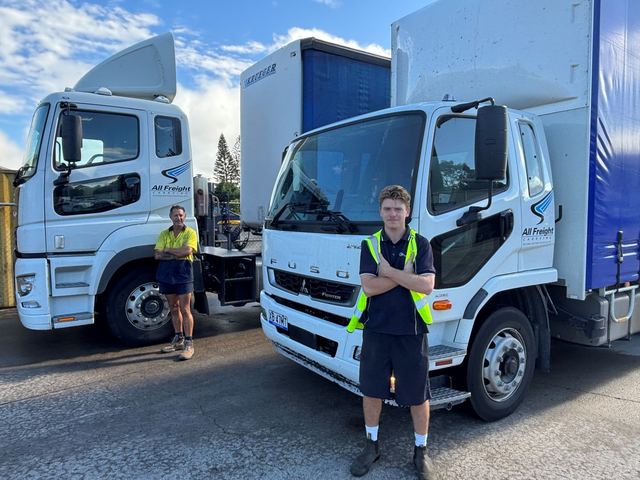



Freight can be delivered to a building site, and All Freight Carrying does it every business day across the Sunshine Coast, Noosa, the hinterland, Gympie and northern Moreton Bay — but a site delivery needs three things an ordinary business delivery does not: a named contact who is actually on site, honest information about access and ground conditions, and a decision about who or what is going to unload. Get those three right and site freight is straightforward. Leave any of them off the booking and the vehicle is likely to be turned around.
Why a site is different from a warehouse
A warehouse has a dock, a forklift, a street number and somebody at a desk. A building site often has none of them. The address may be a lot number rather than a street number, the entry may move as the job progresses, the ground changes with the weather, and the only person who can accept the freight may be up a ladder at the other end of the block. On top of that, the crew may not be there at all: trades come and go, and a site that is busy one morning can be empty the next.
None of that makes site freight difficult. It just means the delivery has to be planned rather than assumed, which is why we ask more questions about a site than about a loading dock.
The site contact is the most important detail
Put a name and a mobile number on the consignment for somebody who will be on site and will answer the phone. Not the office, not the client, and not the person who placed the order from another suburb. A driver who can ring ahead from five minutes away can confirm the gate, the drop point and who is signing, and that one call prevents more failed site deliveries than anything else.
Tell us as well if the site has set hours, days it is closed, or a period when it cannot take deliveries because of a pour, a crane lift or an inspection.
Access and ground conditions
Our drivers will not put a vehicle, a load or themselves somewhere unsafe, and under our Conditions of Carriage a site that cannot be entered safely is treated as a futile attempt. Everything below is worth noting on the booking:
- What the vehicle can get to. Entry width, turning space, and whether a rigid truck can get in and out without reversing blind onto a road.
- Ground conditions. Mud, sand, loose fill, soft batters and unformed driveways will stop a loaded truck, and a pallet jack cannot move a heavy pallet across any of them. Hinterland and acreage blocks around Maleny, Montville, Kenilworth and the Mary Valley often need a smaller vehicle for exactly this reason.
- Overhead limits. Awnings, car park entries, scaffolding, temporary power and low branches.
- Gates, codes and compounds. Give us the code or the name of whoever holds the key.
- Where the freight actually goes. A nominated hardstand drop point near the entry is far better than an optimistic plan to get a truck to the back of the block.
- Traffic and street works. Road closures, no-standing restrictions and one-way streets, which matter in the beachside streets and in town centres.
Who or what is going to unload?
This is the question that decides which vehicle we send, so answer it before you book rather than on the day:
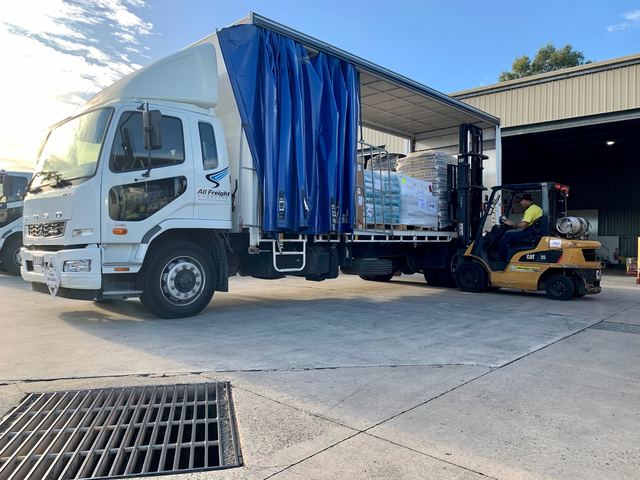
- A forklift or telehandler on site. The quickest option. Pallets come straight off the tray, and we can send a curtainsider or a flat tray.
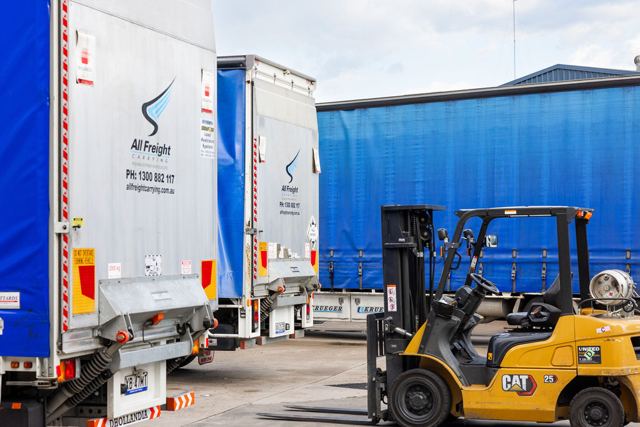
- A tailgate delivery. The truck’s hydraulic platform lowers the pallet to the ground, so no lifting equipment is needed on site. The platform needs firm, level ground at the back of the truck, every tailgate has a lifting limit, and the pallet is left at the back of the vehicle rather than carried across the site.
- Hand unload. Fine for cartons and lighter items. Tell us if the driver will be unloading alone and how many items there are, because a pallet broken down by hand takes time and some items are simply not a one-person lift.
- Craneage or a hiab. Lifting freight over a fence or onto an upper level is a different job again. Tell us at the quote stage so the right vehicle and equipment are arranged rather than discovered.
Site crews are often willing to help unload, but do not build the delivery around it. If the only plan is “the boys will give him a hand” and the crew has gone to another job, the freight goes back to the depot.
Long, tall and oversize items
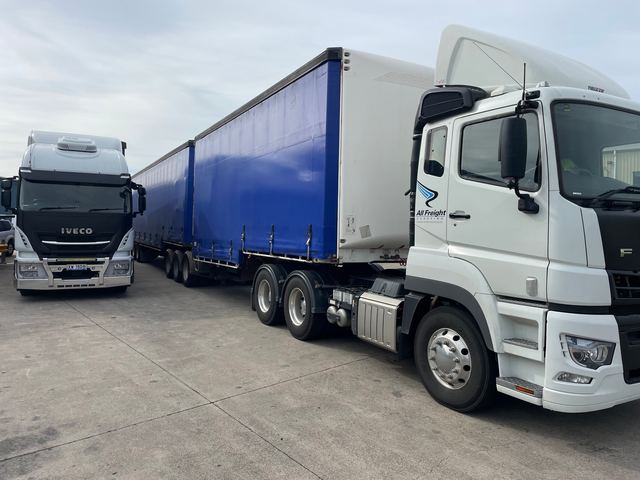
Site freight is full of items the parcel networks will not touch: timber and steel lengths, trusses, sheeting, pipe, bench tops, glass, tanks, cabinetry and plant. We carry this sort of freight on trays, curtainsiders and trailers rather than through a parcel conveyor, so it arrives in one piece rather than with a surcharge and an apology. Give us the real length, width, height and weight of each item, plus the weight of the heaviest single piece, and say if anything cannot be laid down, stacked on or tilted. Our guide to oversize and awkward freight covers how these items are measured and charged.
Long lengths also change the access conversation, because a vehicle carrying six-metre material needs somewhere to get in, stop and get out again.
Timing, without pretending to be something we are not
Site freight travels on the same network as everything else. Deliveries across the coastal centres, Nambour, Gympie and Caboolture run every business day, while hinterland, rural and island areas are serviced on set days each week, so a site on the range or in the Mary Valley has a known day rather than a daily service. Freight collected in Brisbane travels north on our overnight linehaul and is delivered on the next run for that area.
We cannot promise a clock time, and we would rather say so than have a crew standing around waiting. What we can do is tell you which run the site is on and roughly where in that run it falls, plan around a known constraint such as a pour or a crane, and move the freight on a dedicated vehicle if it genuinely cannot wait — see urgent and hot shot freight. For staged jobs, the better answer is usually to hold the materials and release them as the job needs them instead of landing everything at once.
Site rules and paperwork
Tell us about anything the driver has to do before entering: sign-in, an induction, a permit, high-visibility clothing, boots, a hard hat, a speed limit, a one-way route through the site, or a requirement to report to a site office first. Our drivers carry and wear standard personal protective equipment, but a site-specific induction has to be arranged in advance, not at the gate.
Proof of delivery from a site
Every delivery is scanned, with a GPS and time stamp and either a signature or a photograph of where the freight was left. On sites that matters more than anywhere else, because the receiver is often not the person who placed the order and the freight is frequently left in a yard rather than handed over at a counter. If you need the proof of delivery for a progress claim or a dispute, ask us and we will send it through.
Booking a site delivery
Call 1300 882 117 between 8:00am and 4:00pm Monday to Friday, email cs@allfreightcarrying.com.au, or request a quote online. Have the site address and lot number, the site contact’s name and mobile, the item list with dimensions and weights, the unloading method and anything unusual about the access. Our service areas page shows how often we deliver to each suburb, and our depot is at 48 Central Park Drive, Yandina QLD 4561 if you would rather drop freight to us.
Published by All Freight Carrying, Yandina, Sunshine Coast · 31 October 2026 · Last updated 31 October 2026