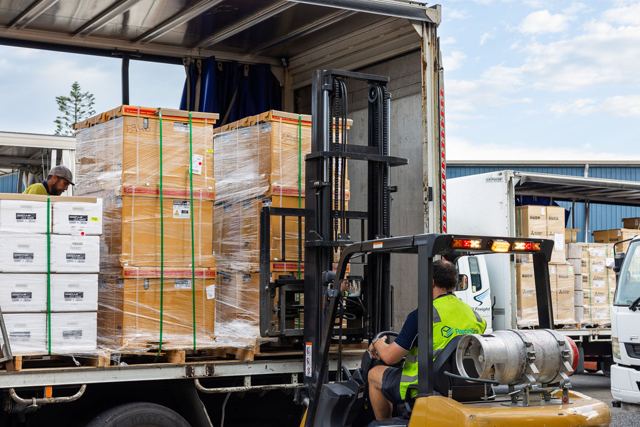



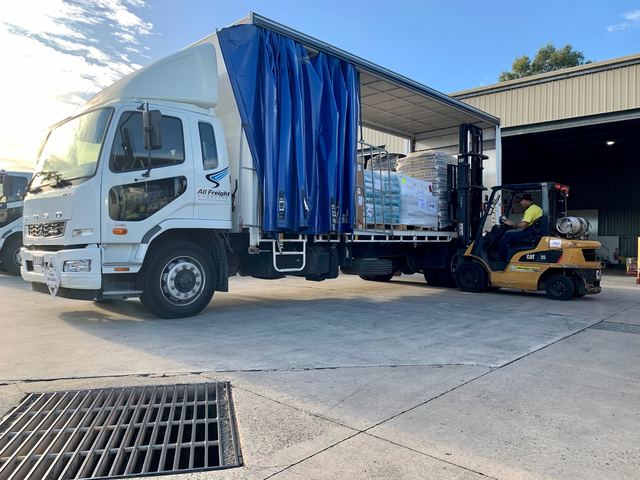
To send a pallet interstate from the Sunshine Coast, build it square and wrapped to the base, measure and weigh it, and ask All Freight Carrying for a quote with the pickup suburb, the destination suburb and whether either end has a forklift. Our own driver collects the pallet anywhere on the Sunshine Coast or in Gympie, it is checked and consolidated at our Yandina depot, and it travels on established national carrier networks to every capital city and regional centre in Australia, booked and tracked by our office through to proof of delivery. No account is needed for a single pallet.
Step 1: build a pallet that will travel
Interstate freight is handled more often than local freight: it is loaded at the pickup, unloaded and checked at Yandina, loaded onto the linehaul, cross-docked at the other end and delivered. A pallet that survives that is built on a sound base with no broken boards, stacked square with the heaviest cartons at the bottom and nothing hanging over the edges, and shrink-wrapped down to the pallet base, with straps on heavy loads. Label at least two sides with the receiver’s name, address, suburb, postcode and phone number. Our guide to packaging freight so it arrives undamaged covers cartons, long lengths and fragile items.
The Australian standard pallet is 1165 × 1165 mm, and most freight networks plan space around it. Euro, US and half pallets travel too; give us the actual dimensions. See standard pallet sizes in Australia.
Step 2: measure and weigh it as it will travel
Measure the length, width and height including the pallet base and anything that sticks out, and weigh the whole pallet. Road freight is charged on the greater of the actual weight and the cubic weight, which converts the space the pallet takes up into a weight at 250 kg per cubic metre. A pallet of light, bulky goods is charged on its size; a pallet of tiles on its weight. Work yours out with the cubic weight calculator, or read what cubic weight is. A pallet that turns out larger or heavier than declared is re-rated at its actual size, so round up.
Keep pallets under about 1.8 m high including the base where you can, and tell us at booking if a pallet is over 1,000 kg, over 1.8 m high or an unusual shape, so the right vehicle and equipment are allowed for. Our guide to how much a pallet weighs has typical figures.
Step 3: tell us about both ends
A quote needs the pickup suburb and the destination suburb and postcode, the number of pallets, their dimensions and weights, a short description of the goods, and what is at each end to load and unload them. If there is a forklift or a dock at both ends, a standard vehicle does the job. If either end has neither, a tailgate is needed: our rigid curtainsiders all have tailgates for the pickup, and tailgate or residential delivery at the destination is requested at booking and confirmed with the quote. The full checklist is in what a freight quote needs.
Dangerous goods, such as paint, aerosols, adhesives, pool chemicals and lithium batteries, must be declared in writing before booking. Refrigerated goods, perishables, engines, machinery and vehicles are not carried unless agreed in writing first. See what you must declare.
Step 4: book the pickup and the consignment
We reply with a price and a transit estimate, normally the same business day. Once you accept, the pickup is booked with our own driver on the Sunshine Coast or Gympie run, and the pallet can go in the same pickup as your local and Brisbane freight. Have the consignment note details ready: sender, receiver, item count, dimensions and weight. If the pallet is on a CHEP or Loscam hire pallet, give us the transfer details too; our guide to CHEP and Loscam pallets explains why.
Step 5: tracked from pickup to proof of delivery
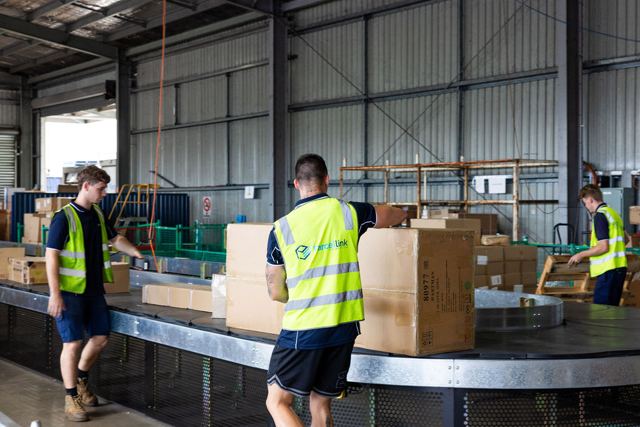
The pallet is scanned at pickup and into the Yandina depot, where it is checked and measured before it leaves the coast on established national carrier networks for the destination state. It has one consignment note and one tracking number through to delivery, and our office on the Sunshine Coast is the number you ring if you need to know where it is. Proof of delivery is available in tracking.
How long does a pallet take to get interstate?
Estimates in business days from pickup, excluding weekends, public holidays and the day of collection, confirmed with every quote:
| From the Sunshine Coast to | About |
|---|---|
| Brisbane (our own trucks) | Next business day |
| Sydney, Newcastle, Melbourne | 2 to 3 business days |
| Canberra, Wollongong, Geelong | 3 to 4 business days |
| Adelaide | 4 to 5 business days |
| Perth | 5 to 6 business days |
| Hobart, Darwin | 6 to 7 business days |
| Townsville, Cairns, Mackay, Rockhampton | 2 to 3 business days |
Regional towns are delivered out of the nearest major centre and can take longer than the capital. Check any suburb in Australia on the transit times page.
Sending more than one pallet?
Several pallets for the same receiver travel on one consignment. Regular interstate senders can have a standing pickup and a credit account; one-off senders are welcome without one. For the whole service, see interstate courier and freight from the Sunshine Coast.
Published by All Freight Carrying, Yandina, Sunshine Coast · 9 November 2026 · Last updated 9 November 2026