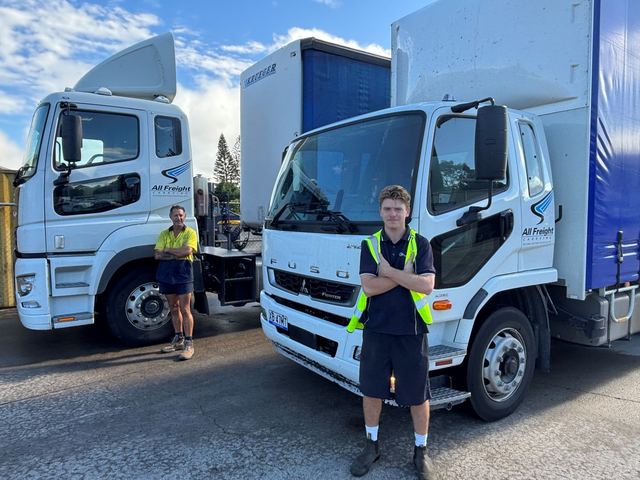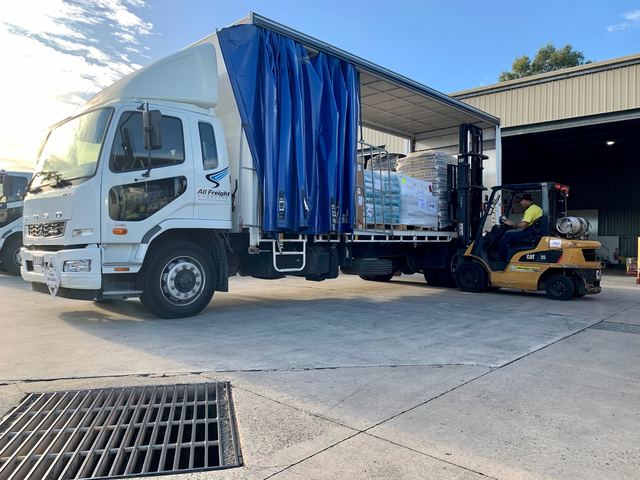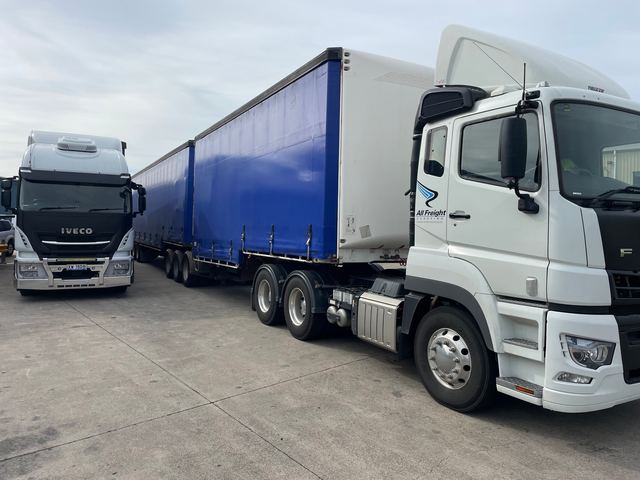



To quote your freight, All Freight Carrying needs to know where it is collected, where it is delivered, what it is, how many items there are, their dimensions and weight, what is at each end to load and unload it, and when you need it moved. With those details the office can match the freight to the right vehicle and run and reply with a price and a transit estimate.
Where is it going from and to?
The pickup suburb and postcode and the delivery suburb and postcode come first, because they decide which lane and which run the freight sits on. A pickup in Brisbane for the Sunshine Coast goes on our overnight linehaul to Yandina and out on a Coast run the next business day; a hinterland, rural or island address is delivered on its set service day; an interstate address leaves Yandina on a national network. The suburb and postcode at both ends are enough to quote; we need the full address, a contact name and receiving hours before we book.
What is the freight?
A short plain description tells us how to handle it: two pallets of boxed tiles, one carton of brochures, six lengths of aluminium extrusion. It decides whether the freight travels on a parcel run or a truck, and whether it is something we carry at all. Refrigerated or temperature-controlled goods, perishables, engines, machinery and vehicles are not carried unless agreed in writing first, so say so up front.
How many pallets or items, and how big and heavy are they?
Give the number of pallets, cartons or loose items, and the length, width, height and weight of each. Freight is charged on the greater of its actual weight and its cubic weight, so a light but bulky carton is charged on the space it takes up. Our guide to what cubic weight is explains the calculation, and the cubic weight calculator works it out for you. Measure the freight as it will travel, including the pallet and any overhang, and round up. A consignment that turns out larger or heavier than declared is re-rated at its actual profile, so measure accurately at the start.
Is it a business or a home at each end?
Tell us whether each end is a business with receiving hours or a home. Homes are a normal part of every run, but they are handled differently: there is rarely a forklift, the delivery is made at ground level to the front door or kerbside, and residential delivery is charged as an additional service. Our guide to business versus residential delivery sets out the differences.
Is there a forklift, a dock or neither?
If there is a forklift or a dock at truck height at both ends, a standard truck does the job. If there is neither at the pickup or the delivery, the freight needs a tailgate truck, which lowers the pallet to the ground on a hydraulic platform. A tailgate must be requested when you book, needs firm level ground, and has a lifting limit, which is why we ask for the weight of each pallet.
When do you need it collected and delivered?
Tell us when the freight will be ready and when you need it at the other end, and we confirm what is possible. Freight between Brisbane, the Sunshine Coast and Gympie travels next business day on our own vehicles; hinterland, rural and island areas run on set days each week; interstate destinations vary with the route. Every transit time is an estimate, confirmed with every quote, counted in business days from pickup. If the freight cannot wait for a scheduled run, say so and we will quote a dedicated vehicle, dispatched as soon as a suitable vehicle is available.
Does it need special handling?
- Dangerous goods. Aerosols, paint, adhesives, pool chemicals, gas bottles, lithium batteries and anything that holds fuel or oil must be declared in writing before booking, with the UN number, proper shipping name, class and packing group from the Safety Data Sheet. Undeclared dangerous goods are never carried; our guide to what you must declare covers the paperwork.
- Fragile items. Glass, ceramics and electronics travel through a depot and a cross-dock, so tell us they are fragile and pack them for it.
- Long lengths and awkward shapes. Pipe, timber, extrusion and panels need the right vehicle, so give the longest dimension and the number of pieces. See oversize and awkward freight.
- Site requirements. Inductions, gate codes, height limits and restricted hours.
Is this a one-off or regular freight?
One-off jobs are welcome and need no account: the job is quoted, paid and booked. If you send regularly, it is worth opening a credit account, which gives you rates set for your freight rather than a quote each time, invoicing on account and portal logins so your team can book and track directly. Tell us roughly how often you send, because a regular pattern is quoted differently from a single consignment.
The quote checklist
| Item | Why it matters |
|---|---|
| Pickup suburb and postcode | Sets the collection run and the lane the freight travels on |
| Delivery suburb and postcode | Sets the delivery run, its service day and the transit estimate |
| Description of the freight | Decides the vehicle, the handling and whether we carry it |
| Number of pallets or items | Decides the space needed and how the job is priced |
| Dimensions and weight of each | Chargeable weight is the greater of actual and cubic weight |
| Business or residential, both ends | Changes access, receiving hours and the services needed |
| Forklift, dock or tailgate | Sends the right truck the first time |
| Ready date and delivery need | We confirm what is possible on the run |
| Dangerous goods, fragile or long | Declared up front, assessed before we accept |
| One-off or regular | Quoted per job, or set rates on an account |
What happens after you send it?
The office at Yandina checks the details, matches the freight to a vehicle and a run, and replies with a price and a transit estimate. Transit times are estimates, confirmed with every quote. If anything needs clarifying, such as a tailgate weight or a dangerous goods classification, we come back to you before we quote. Once you accept, the booking is confirmed in writing and the consignment is scanned at pickup, into the depot, onto the delivery vehicle and at delivery, with a GPS-stamped photo or signature as proof. Have the details ready and request a quote online, or call 1300 882 117, 8:00am to 4:00pm, Monday to Friday.
Published by All Freight Carrying, Yandina, Sunshine Coast · 5 November 2026 · Last updated 5 November 2026